Introduction by Helen Smith Tarchalski,
Editor 
aniel is a bright ten-year-old in my studio
who is very interested in playing the piano and using all tools
available for that pursuit. At one lesson, I pointed out to
him how fortunate he is to have video camera technology available
to monitor his technique, and explained that home videotape cameras
had not even been invented when I was growing up. His eyes widened
in disbelief. His eyes further widened with each additional piece
of information I revealed about my own young years as a piano
student: records instead of CDs ("Mrs. Tarchalski, what's
a 'record'," wondered Daniel), no cassette tape recorders,
no personal computers ("What did you do, share computers?"),
no answering machines for mothers to leave messages to teachers,
no digital pianos, and no microwave ovens to allow my teacher
a 30-second coffee warm-up between students.
After allowing all this information to digest for about ten seconds, Daniel queried, "Mrs. Tarchalski, when you were little, was there electricity?" Now, thinking of myself as relatively far from the "one-foot-in-the-bone-yard" stage of life, I thought that he was surely joking. However, noting the sincerity on his face, I quickly recognized that this was my lesson in historical relativity through a young student's eyes. Daniel helped me to understand why young students often find it difficult to grasp certain aspects of music history. Because of their limited experience with and distorted concept of the passage of time, they simply can't "relate."
Few if any teachers debate the importance of music history,
and most desire to introduce and expand a student's knowledge
of music history as an integral part of the weekly lessons. Yet
a topic that is universally agreed upon as being of great value
to the student's whole musical experience too easily slips to
the "back burner" of many well-intentioned teachers'
lesson plans. In this issue you will find references to engaging
activities, teaching aids, and resources for cultivating an awareness
of music history as relevant, meaningful, and therefore, a topic
that positively influences a student's playing, from the youngest
beginner through the more sophisticated older student
Article by Karen Koch
athan was ten years old when he changed
the course of my teaching with his answer to my question, "Does
anyone remember in what historical period Mozart lived?"
Wrinkling his forehead, Nathan responded, "Well I don't know
what period it was, but I think it was ... [pause] ... sometime
between Grandpa and Jesus?"
I realized that Nathan was trying to compensate for my poor job of teaching music history, and he was showing me a way to do that. I resolved to improve. I already understood that knowledge of music history made my playing more meaningful and my life more interesting. I began seeking ways to share that with my students by making music history personally relate to their own lives. Some strategies I've discovered to achieve this are:
Start students with a structure for organizing historical information. My students use a "Milestones of Music History" chart to help them structure history into five basic compartments to form a mental filing cabinet: Baroque, Classical, Romantic, Twentieth Century, and Other. Isolated dates aren't as helpful as a sequence of events, and fortunately the periods are in alphabetical order!
Appeal to their senses and emotions-not just their intellect. Use colors, sound, movement, stories, drama, art, games, and imagination when filling that filing cabinet.
Make history student-centered. Relate to their lives, their music, their other studies. Work from the known to the unknown, i.e. "This piece was already two hundred years old when your grandmother played it!" or "Your piano has a damper pedal. Baroque composers did not have that."
Reinforce-briefly but frequently. Once students comprehend a historical framework, they retain information more easily. Follow up, using their personal repertoire, and point out similarities and differences between music and composers of the same period. Every lesson should include several casual historic references.
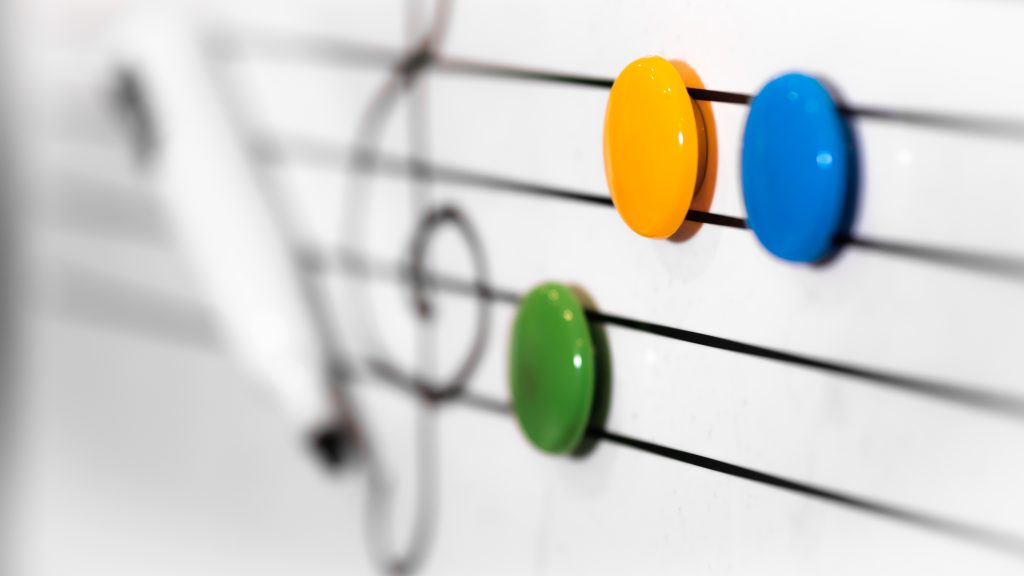
Associate a color with each period: Try Baroque = gold (royalty, nobility, ornamentation); Classical = blue (refinement, structure); Romantic = red (strong emotion, surprising harmony); and 20th Century = green (the color of growth, and a combination of earlier colors). Music, historical events, composers, clothing, and hairstyles are all quickly related with a color code. Dots or highlighters can add color-coding for CDs, written reports, or bulletin board displays. Multiple colors indicate items that span several periods. Instantly relate each newly assigned piece to its period by having the student swipe a colored highlighter over the composer's name on the music.
Help students organize their materials. A binder with slip-in covers and dividers works best in my studio. Each student uses it not only for assignment and study sheets, but also for clippings, composer biography reports, photos, recital programs and other meaningful items to create a true history of his or her personal music study.
Create a history-rich environment. A studio bulletin board can display composer portraits, posters, clippings, and student reports. Studio waiting areas are ideal for doing a jigsaw puzzle or browsing through past issues of Piano Explorer. Create a while-you-wait matching game of composer/ period/country/composition on blank business cards. Use the four music history colors (gold/blue/red/ green) on a wall or table as a background for pictures and cards decorated with the composer's name, date, biography, and composition titles. Use a historical chart on the front of student assignment books.
Make history immediate. Point out that the markings and mood of a piece are the composer's way of communicating beyond the grave. Write a letter to or arrange a visit from a living composer. Take photographs and collect autographs when you meet current composers at workshops or conventions. Arrange for a composer, teacher, or student to dress in costume for a performance of Western or ethnic music. Use the harpsichord setting on digital keyboards to simulate Baroque music's sound and ornamentation.
Use group settings to enhance historical knowledge and enjoyment. Classes and recitals provide a perfect setting for history. Students can verbally introduce their pieces, then place a homemade bookmark at that composer's spot on a display timeline. A projector can show the composers' pictures on the wall during each piece. Historical recitals can incorporate period costumes, music, and art. A field trip to a museum, concert, or a neighboring college's harpsichord and organ is memorable. Games dealing with composers and/or music history are effective. Music history is a perfect theme for a camp that is based on vocabulary, performance practices, musical forms, society, clothing, instruments. Students could dramatize a composer story or event. (Editor's note: Some teachers host composer birthday parties, complete with cake, ice cream, and party hats. The gifts the students bring are polished performances of the celebrated composer's music. This could also be a festival idea for a teacher association group.)
Use new technology. Available software programs range from simple date/name drills to highly entertaining multimedia presentations showing people, places, related arts and events. Teachers who have labs can expand their lesson time exponentially. Even without a studio lab, teachers can assign independent research on Internet sites that are brimming with fascinating information.
How do I incorporate music history into the lesson? I provide a structure, a rich environment, frequent historical references, and let students enjoy - perpetually!
Activity Kit: My Own Music History by Karen Koch. A student activity kit with timelines and repertoire sheets for creating a record of personal music study. Good for individual, class, or camp.
Audio Tapes: Composer Biography Audio Tapes by Brad Thompson. Five sets, 21 composers, six musical periods for ages 8 and up.
Book: The Music Box: The Story of Christofori by Suzanne Guy. A delightful story that separates fact from fiction about the pianoforte.
Camp Plans: Summer Camp or Christmas Camp by Bonnie Slaughter. Detailed schedules and activities ready to captivate participating students.
Game: Composer Bingo by Barbara Rader. Game with laminated playing cards and color-coded calling cards.
Game: Composers Game by Jane Calder. A matching game with laminated information cards about 15 great composers. Instructions for other teaching uses included.
Jigsaw Puzzle: Periods of Western Music by Karen Koch.
Video: Meet the Musicians Video Series by Meet the Musicians Productions. Five carefully researched videos by Dennis Kobray, who appears and performs as Mozart, Beethoven, Bach, Gershwin, and a friend of Joplin. Ages 8 and up.
![]() 1.8 MB, QuickTime movie file |
![]() 1.6 MB, QuickTime movie file |
Book: Bach, Beethoven, and the
Boys: Music History as It Ought to be Taught and If It
Ain't Baroque ... More Music History as It Ought to be Taught
by David W. Barber; illus. by Dave Donald. Toronto: Sound and
Vision, 1992. Paperback. Historical facts in humorous presentations
that will supply teachers and older students with a new appreciation
for what has gone before.
Book: Famous Children Biographies. Series by Ann Rachlin. Published by Barrons Juveniles. Paperbacks, 24 pages each. These books tell amusing stories of the early years of great composers including Bach, Beethoven, Brahms, Chopin, Handel, Haydn, Mozart, Schubert, Schumann, and Tchaikovsky.
Book: Stories of Composers and Stories of Women Composers by Catherine Wolff Kendall. Edwardsville Illinois: Toadwood Publishers, 1985. Multi-page stories of 40 men and 31 women composers. Includes portraits, calendar of birthdays, sources of music by featured composers, pronunciation guide.
Books and Music: The Baroque Spirit; The Classical Spirit; The Romantic Spirit by Nancy Bachus, Alfred Publishing. Photos, maps, and meticulously researched information on composers and their music. The piano solos range from early intermediate to intermediate levels and reflect the society, style and musical trends of each period.
Books and Projects: Time Traveler's Guide to Music History by Susan Christiansen and Kevin Mitchell. Alfred Publishing Company. Two volumes with information on evolution of composers, musical styles such as blues, rock, ancient Africa, and a one-page piece of music. Accompaniment disk available in style and instrumentation of the period.
Books and Projects: Meet the Great Composers by June C. Montgomery and Maurice Hinson, Alfred Publishing Company. Books 1 and 2 each have a book and CD, a Classroom Kit with activity sheets, and a Repertoire Book.
Bookmarks: Composer Bookmarks-A Sketch and a Quotation by June Christenson, 88 ST. Publishing, 7693 Sunrise PL East, Sale Lake City UT 84084. Set of 24 composers includes copying masters.
Children's Magazine: Piano Explorer, 200 Northfield Road, Northfield IL 60093. Much historical information in stories, puzzles, activities, music, color illustrations. Ten issues per year.
Composer Coloring Books: 12 books, 12 composers from Bach to Prokofiev. By Leonyce Thompson Kidd Hill, MBT Publications. 843-571-4811. $4.95 each.
Poster: Celebrating Women Composers! 18x 24" timeline poster featuring 200 women composers from the ninth century to present. Leonarda Productions, Inc., PO Box 1736, New York NY 10025-1559. (212) 666-7697.
Technology: Zane Publishing, Inc. 2425 Arbuckle Street, Dallas TX 75229-4506, (972-488-9263), www.zane.com. Many CD ROM titles for classical music, music appreciation, instruments, folk music, musical periods, and art and music. In many, a narrator reads a story while the student can view words, illustrations and music on the screen.
(Editor's note: In addition to the aforementioned fine resources and products, also consider these popular teaching aids available through music stores and various catalogs: the Classical Kids audio tape series and Beethoven Lives Upstairs video tape [The Children's Group, Toronto, Ontario, Canada]; and the Performance Practices video tape series [presented by Maurice Hinson, Alfred Publishers]. The teaching aids from the Children's Group are captivating for young students. The Performance Practices videos [see two clips below] are geared toward older students and teachers, focusing on one historical period per video. Hinson provides references to art, literature, anecdotal information about the composers, and dancers in costume demonstrating dances discussed in the videos.)
![]() 2.1 MB, QuickTime movie file |
![]() 1.6 MB, QuickTime movie file |
www.karadar.it an Italian site with a composer's dictionary, picture gallery, live recorded mp3 files, and other information for over 2000 composers.
utopia.knoware.nl/~jsmeets/cgi-bin/ccd.cgi?comp=phome Includes alphabetized composer database, birth/death date calendar, and an "Information Wanted" section.
www.classical.net/music/ A guide to composer data and works.
voyager.physics.unlv.edu/webpages2/picgalr2.html Classical composers archive with pictures, bio info, and nationality indexed.
datadragon.com/day/ This Day in Music History.
w3.rz-berlin.mpg.de/cmp/classmus.html Information about music or composers according to musical epoch, form, or composer's name.
KAREN KOCH,
NCTM, is the originator/coordinator of Music Educators' Marketplace,
an online store for independently created materials and a forum
for music educators. She studied with Murray Baylor at Knox College,
and received her MA from Webster University where she studied
with Daniel Schene. She has taught students in Montessori pre-school
through college level, is a church musician, is active in St.
Louis and southern Illinois area MTA groups, and currently conducts
an independent studio of 30 students.